


The Economics of an Ageing Population

Britain's Next Big Challenge
Tap to Section
What happened?
Britain is growing older, and the economic effects of this demographic shift are becoming impossible to ignore. With life expectancy rising and birth rates falling, the balance between working‑age adults and retirees is steadily tilting, placing new pressures on everything from public finances to the labour market.
What was once a distant policy concern is now a defining challenge for the coming decades, shaping how the UK will fund pensions, staff essential services, and support a population that is living longer than ever before. As the country adjusts to this new reality, the question is no longer whether ageing will reshape the economy, but how prepared Britain is for the scale of the change ahead.
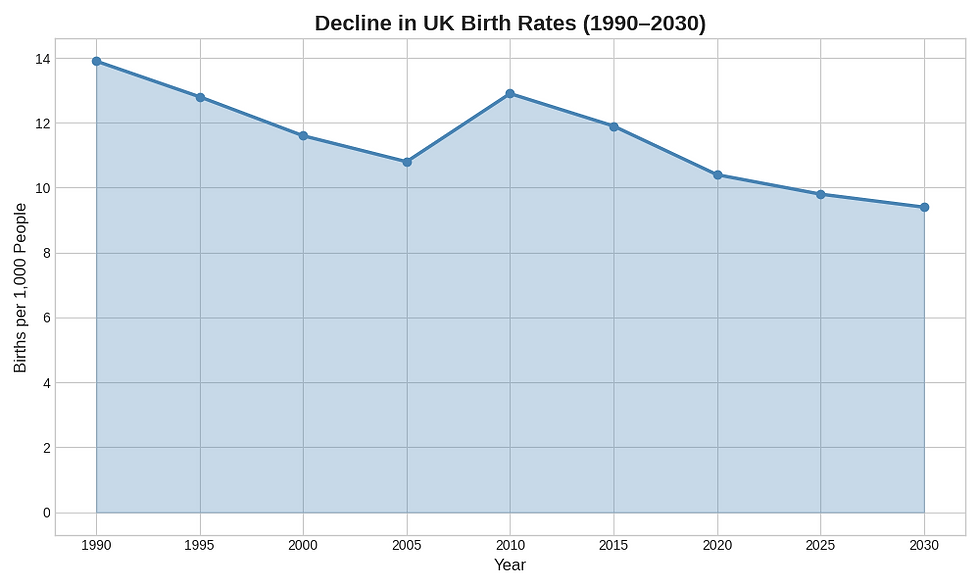
Britain’s demographic profile is undergoing a profound transformation, with the population ageing at a pace that is reshaping the country’s economic and social landscape. According to the Office for National Statistics, the number of people aged 65 and over is projected to rise from 11 million today to nearly 15 million by 2045, meaning almost one in four UK residents will be of retirement age. At the same time, the proportion of children and young adults is shrinking, and the working‑age population is growing far more slowly than in previous decades. The old‑age dependency ratio — the number of retirees relative to working‑age adults — is expected to climb from around 30% today to over 40% by the mid‑2030s, placing increasing pressure on public finances, pensions and the labour market. These demographic shifts are not abstract trends; they represent a structural change that will define Britain’s economic trajectory for decades.

The Problem?
As the population ages, the strain on Britain’s public finances intensifies. A growing share of government spending is absorbed by pensions, healthcare and social care—areas that expand rapidly as the number of people aged 65 and over rises. At the same time, the tax base grows more slowly because there are fewer working‑age adults relative to retirees, meaning less income tax, National Insurance and productivity‑driven revenue to fund these commitments. This widening gap between what the state must provide and what it can raise creates long‑term fiscal pressure, forcing governments to confront difficult choices: raising taxes, cutting spending elsewhere, increasing borrowing, or reforming the pension and welfare systems. In effect, demographic ageing doesn’t just reshape society—it reshapes the entire structure of the UK’s public finances.
As Britain grows older, the economic burden between generations risks becoming increasingly unbalanced. A larger retired population depends on a smaller pool of working‑age adults to fund pensions, healthcare and social care through taxation, meaning younger people carry a rising share of the financial load. At the same time, older generations typically hold disproportionate wealth—especially in housing. Younger adults face higher living costs, stagnant wages and reduced access to home ownership. This widening gap creates a sense that the system is becoming less fair, with younger taxpayers contributing more to support services they may struggle to access themselves in the future. If left unaddressed, demographic ageing could entrench long‑term intergenerational inequality, shaping not only economic outcomes but also social unity and political attitudes.
Is There an Opportunity?
Despite the challenges, an ageing population also opens the door to significant economic opportunities. Demand for healthcare, leisure, financial services and age‑friendly housing is set to grow. This could create new markets and drive innovation in everything from medical technology to home design. Older adults are also an increasingly active part of the economy—working longer, starting businesses and contributing valuable experience to the workforce. Together, these trends form a rapidly expanding “silver economy” that could become a major source of growth for Britain in the decades ahead.
What can the Government Do?
To manage the pressures of an ageing population, Britain could draw on a wide toolkit of policies already being tested around the world. Some countries have focused on keeping older adults in the workforce for longer, with Japan offering subsidies to companies that retrain older employees and redesign roles to suit their changing abilities. Others, like Sweden and Denmark, have strengthened lifelong learning systems, helping workers update their skills throughout their careers so they can remain productive well into later life. Immigration policy is another lever: Canada and Australia have used targeted, skills‑based migration to stabilise their working‑age populations and support economic growth. Meanwhile, countries such as Germany have invested heavily in modernising social care, expanding community‑based services and using technology to reduce strain on hospitals. For the UK, a mix of these approaches — from pension reform and workforce participation incentives to smarter migration and investment in care infrastructure — could help ease fiscal pressures while ensuring that longer lives remain an economic asset rather than a liability.
Why it matters?
Britain’s ageing population isn’t just a statistic — it’s a shift that will shape the country for decades, and how we respond now really matters. The decisions made around pensions, healthcare, work and migration will determine whether longer lives become a strain on the system or a chance to rethink how the economy works. Other countries have shown that with the right mix of planning and innovation, ageing doesn’t have to be a problem; it can even create new opportunities. For the UK, the challenge is to take that same forward‑looking approach and build a model that supports older people without placing too much pressure on younger generations. The demographic change is already happening, but the outcome is still very much in our hands.
Glossary
Ageing Population [Economy] [General]
... a demographic shift where the median age of a country or region rises, resulting in a higher proportion of people aged 65 and over compared to younger age groups.
... this is driven by increased life expectancy and declining fertility rates.
Demographic [Economy] [General]
... the statistical characteristics of a population, broken down into categories like age, gender, income, race, education, and employment.
... governments and businesses analyse this data to understand population trends, make policy decisions, and create targeted marketing strategies.
Government Spending [Economy] [Politics]
... the expenditure spent by the public sector (government organisations and institutions) to provide goods and services, such as healthcare, education, and defence, etc.
Immigration Policy [Economy] [Politics]
... the rules, regulations, and guidelines a government establishes to control the entry, stay, work, and citizenship of non-nationals.
Intergenerational [Economy] [General]
... involving individuals of more than one generation.
... varying in ages, this is the crossover of one or multiple demographics.
Office of National Statistics (aka 'ONS') [Economy] [Politics]
... statistics and information about the UK's economy, population, and society, collected, analysed, and published by the Office for National Statistics (ONS), the UK's largest independent producer of official statistics, covering everything from GDP and inflation to crime, migration, and census data for government, business, and public use.
Policy [Economy] [Politics]
... a set plan for action followed by a business, a government, a political party, or a group of people.
Population [Economy] [General]
... the numbered group of individual persons, objects, or items living in a particular space/ place, used for statistical measurement.
Tax Base [Economy] [Politics]
... the total value of assets, income, transactions, or properties that a government can legally tax.
... this represents the pool of economic activity of how tax revenue is generated, separate from the tax rate (the percentage applied to that base).
Welfare [Economy] [Politics]
... help given by the state or an organisation/ charity to people who need it.
Sources
1 - Ons.gov.uk
2 - Copilot


Mình mua vé số chủ yếu cho vui thôi, kiểu có cái để hóng kết quả mỗi ngày chứ không đặt nặng chuyện đổi đời. Trước đây nghe bạn bè bàn về “cầu kèo” này nọ, mình tò mò thử theo dõi, lúc đầu thấy rối rắm nhưng xem dần thì cũng nhận ra vài chỗ hay bị lặp. Có khi mình đọc mấy bài nhận định như https://soicauxsmb.io/phan-tich-xsmb.html rồi tự note lại vài ý, sau đó đem so với kết quả để kiểm tra xem có phải mình đang tự tưởng tượng ra quy luật không. Trúng được chút thì vui thật, nhưng nhiều lần sai bét nên mình luôn tự nhắc đừng tin quá. Nói chung coi dự…
Mình thỉnh thoảng cũng nghía mấy cách soi cầu âm dương cho vui thôi, coi như thêm góc nhìn chứ không dám đặt niềm tin hết. Hồi trước toàn chọn theo linh cảm, có bữa trúng có bữa trật nên dễ tụt hứng. Sau này mình thử tìm hiểu kiểu cân đối chẵn lẻ, rồi nhìn lại chu kỳ từng giai đoạn xem nó hay nghiêng về phía nào, cảm giác đỡ mông lung hơn. Đọc mấy bài giải thích đơn giản, nhất là chỗ nhắc đừng cố gò quy luật khi số liệu không nói lên điều gì, mình thấy hợp. Mình có thử ghi lại vài kỳ rồi áp dụng Dự đoán XSMB âm dương theo kiểu tự…